Cool Blue Outer Glow Pointer
‏إظهار الرسائل ذات التسميات note. إظهار كافة الرسائل

علاج الاسنان بالليزر

استخدامات الليزر في طب الاسنان حسب ال ADA
استخدام الليزر فى الاسنان
في هذا المقال سأستعرض معكم بعض مزايا استخدام الليزر حسب توصيات الجمعية الامريكية في طب الاسنان ADA والتي تم الكلام عنها في مجلس الشؤون العلمية لل ADA.
استخدام الليزر في طب الاسنان

استخدام الليزر في طب الاسنان يزداد يوماً بعد يوم وتضاف عدد من المعالجات التي يمكن اجراءها بواسطة أجهزة الليزر بشكل مستمر, فكما نعلم لاجهزة الليزر انواع وتصنيفات مختلفة فبعضها يزيل النسج الرخوة والبعض يتعامل مع النسج الصلبة وهناك انواع يمكن أن يكون لها تعديلات بحيث تعمل على مدى متغير من النسج.

اذاً ما هي مزايا واستخدامات الليزر في طب الاسنان يا ترى!
1- المقارنة بين التقليح العادي Sulcular Debridement -Curettage واستخدام الليزر في علاج اللثة

في 2007 تمت المقارنة بين عمق السبر اللثوي probing depth في حال المعالجة التقليدية والمعالجة باستخدام الليزر.
حيث وجد بالنتيجة أنه عند استخدام الليزر بطريقة ثنائية الاشعة أحدهما من النوع Nd: YAG; لازالة ال sulcular epithelium والاخر من أجل ختم الجيب Seal the pocket تم نقصان من عمق الجيوب اللثوية المرضية أكثر منه في حالة استخدام ال Curettage التقليدي.
استخدام الليزر فى الطب
استخدامه الليزر في علاج اللثةحيث وجد أن استخدام الليزر بهذه الطريقة الثنائية والتي تسمى ب Laser-Assisted New Attachment Procedure أو اختصاراً LANAP تساعد على تشكل ملاط جديد cementum-mediated new connective-tissue attachment وتحسن ارتباط اللثة من جديد بالسن.
لتقرأ المزيد عن هذه الدراسة يمكنك ان تدخل على مصدر المعلومة من هنا (اضعط هنا للانتقال)
2- التقليل من مستوى البكتريا Reduction of Bacteria Level

مجموعة الليزر المستخدم في طب الاسنان من المتعارف عليه أنه يسبب التقليل من مستوى البكتريا سواء في مكان الجيب اللثوي أو في الاستخدامات الجراحية للنسج الرخوة, وهذا أمر مهم وحيوي في طب الاسنان حيث أن البكتريا هي حجر الأساس في أمراض اللثة وغيرها من الامرض الفموية.
كما أن الابحاث الجديدة تشير الى أنه بالرغم من ذلك يمكن أن يتم تحسين ذلك أكثر من خلال وضع سوائل ارواء مضادة للجراثيم bactericidal irrigant في الجيب اللثوي وثم تفعيلها بواسطة ال cold laser مما يعطي فعالية أكبر ضد البكتريا.
3- تحسين شفاء الجروح Laser Wound Healing

والمقصود هنا باستخدام الليزر من أجل شفاء الجروح الموجودة وليس مقارنة الليزر بالمشرط العادي.
حيث أن استخدام الليزر منخفض الطاقة low-powered lasers للتحسين من شفاء الجروح الموجودة تمت ملاحظته منذ سنوات في بحوث عن استخدام الليزر, لكن هناك تقارير مختلفة في الأمر.
حيث أن هناك بعض التقارير الحديثة التي اوردت وجود أثر حراري سيء لشفاء الجروح عند استخدام الليزر المنخفض الطاقة.
هذه التقارير المتضاربة جعلت تحسين شفاء الجروح بواسطة الليزر أمر مختلف عليه أو كما يقال بالانكليزية controversial وغير مدعم سريرياً بشكل قوي.
4- تسوية الجذر بالليزر Laser Root Planing

نتج عن استخدام ليزر ال Erbium نتائج جيدة في تنضير الجذور root debridement.
كما اوضحت دراسات عن استخدام ال Er:YAG laser في المختبر على أنه يزيل القلح remove calculus ويقضي على الذيفان السلبي negate endotoxin.
5- المساعدة في تشخيص النخور Diagnosis of Caries

الليزر بتقنية Laser fluorescence يمكن استخدامه للمساعدة في كشف النخور Caries.
ففي الولايات المتحدة يتم استخدام الليزر من نوع أجهزة diode laser بطول موجة 655 نانو متر في هذا الأمر.
6- استخدامات الليزر في النسج الصلبة Hard Tissue Applications

تم الترويج لاستخدام الليزر في طب الاسنان منذ 1998 على أنه سيستخدم لازالة النسج الصلبة مثل: ازالة التسوس, الميناء, العاج.
وبالطبع فإن هذه الاستخدامات يقوم بها الليزر, والليزر الذي يقوم بها من النوع Er:YAG (2.94 µm) و Er,Cr:YSGG (2.78 µm).
لكن حتى الآن لا يوجد دراسات كافية عن جدوى وأهمية استخدامه مقارنة بال Drill التقليدي.
بالطبع تم ذكر جانب الاسنان فقط للنسج الصلبة علماً أن الليزر يستخدم من قبل الجراحين في النسج العظمية الأخرى وله دراسات خاصة به ولكن فقط تكلمنا هنا عما يتعلق في الاسنان.
7- مداواة الاسنان اللبية Endodontics
استحدام الليزر فى الاندو

الهدف الرئيسي في مداواة الاسنان اللبية Endodontics هو cleaning, shaping and sealing للب الاسنان أو root canal system.
استخدام الليزر في المعالجة اللبيةويستخدم الليزر في ال Endodontics في:
– بتر اللب pulpotomy
– قياس تدفق الدم blood flow measurements
– بتر الذروة apicoectomy
– تحسين فتحة ال endodontic orifice
– تطرية الكوتا بيركا.
الخاتمة
هذه كانت نبذة عما أورد في تقرير ال ADA لاستخدامات الليزر جمعته لكم علماً أنه يوجد مزيا واستخدامات أخرى لم اجدها فيه مثل: تقليل النزف بالجراحة والمزايا الجراحية, لكن على ما أظن انه التطرق الاساسي كان فيما يتعلق بالاسنان مباشرة.

  • Digg
  • Del.icio.us
  • StumbleUpon
  • Reddit
  • RSS

طريقة استخدام الـ ProTaper files

طريقة استخدام الـ ProTaper files
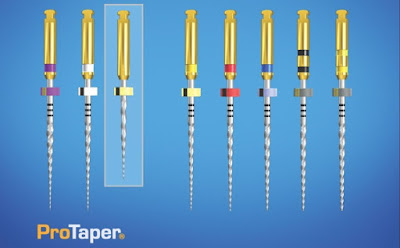
  1. How To Use ProTaper Endodontic Files ---------------------------ProTaper geometries:The Endodontic ProTaper files have a unique features, including:- Changing percentage tapers over the length of its cutting blades. - The progressively tapered design replicates the Schilderian Envelope of Motion technique and servesto significantly improve flexibility, cutting efficiency, and safety. - They are convex, triangular cross-section, which enhances the cutting action while decreasing therotational friction between the blade of the file and dentin.- They have a changing helical angle and pitch over their cutting blades, which reduces the potential ofan instrument from inadvertently screwing into the canal.- The noncutting, modified guiding tip. This feature allows each instrument to safely follow the securedportion of a canal, while the small flat on its tip enhances its ability to find its way through soft tissueand debris.- The ProTaper system is comprised of three Shaping and five Finishing files-----------------------------

  2. There are two types of files for the ProTaper Endodontic Files;"The Shaping Files" and "The Finishing Files" ...The Shaping Files:- Shaping Files are Two: File No. 1 & File No. 2, Termed S1 & S2, Purple and White Respectively. - The Auxiliary Shaping File, termed SX, has no identification ring on its gold-colored handle and, with ashorter overall length of 19 mm. - The S1 and S2 files have D0 diameters of 0.17 mm and 0.20 mm, respectively, and their D14 maximalflute diameters approach 1.20 mm.- SX File, provides excellent access when space is restrictive. The SX file has a D0 diameter of 0.19 mmand a D14 diameter approaching 1.20 mm. - The Shaping files have increasingly larger percentage tapering, allowing each instrument to engage,cut, prepare and shape the canal, performing its own crown down work. - SX File has a much quicker rate of taper between D1 and D9 as compared to the other ProTaper "Sfiles", it is primarily used after the S1 and S2 files to more fully shape canals in "coronally broken down"or "anatomically shorter" teeth.-------------------The Finishing files:- There are five "Finishing files" named F1, F2, F3, F4, and F5 have yellow, red, blue, double black, anddouble yellow colores corresponding to D0 diameters and apical tapers of 20/07, 25/08, 30/09, 40/06,and 50/05, respectively. - From D4–D14 each instrument has a decreasing percentage taper which serves to improve flexibility,reduce the potential for dangerous taper-lock, and reduce the potential to needlessly overenlarge thecoronal two-thirds.
  3. -------------------ProTaper shaping technique: - First, one should know that: The potential to consistently shape canals and clean root canal systems issignificantly enhanced when the coronal two-thirds of the canal is first pre-enlarged, followed bypreparing its apical one-third.-------------------Scout the coronal two-thirds: - "Hand files" sizes 10 and 15 are measured and precurved to match the anticipated full length andcurvature of the root canal. - The 10 and 15 hand files may be utilized within any portion of the canal until they are loose and asmooth reproducible glide path is confirmed.- The loose depth of the 15 file is measured and this length transferred to the ProTaper S1 and S2 files.-------------------Shape the coronal two-thirds: - The secured portion of the canal can be optimally pre-enlarged by first utilizing S1, then S2. Prior toinitiating shaping procedures,- The pulp chamber is filled with a full strength solution of NaOCl. - Without pressure, the ProTaper Shaping files are inserted into the canal and follow the glide pathfreely and easily.

  4. For more optimize safety and efficiency, the Shaping files are used, like a brush, creating lateral space,which will make the Shaping file’s larger, stronger, and of more active cutting blades.- N.B: this brush-cutting action can be used to:Eliminate cervically positioned triangles of dentin,More effectively shape into fins, isthmuses, and canal irregularities, andTo relocate the coronal aspect of a canal away from furcal danger. - N.B: If any ProTaper File ceases inside the secure Portion of the canal, then withdraw it and know thatthe debris blocked the intrablade spaces making the walls push the file away and decrease the cuttingeffeciency.- N.B: Upon removing each Shaping file, visualize where the debris is located along its cutting blades tobetter appreciate the region within the canal that is being prepared. - Following the use of each Shaping file, irrigate, recapitulate with a 10 file to break up debris, and moveit into solution, then re-irrigate.-----------------Scout the apical one-third:- The apical one-third of the canal is fully negotiated and enlarged to at least a size 15 hand file,Working length confirmed, then the patency file is established. - NOW, A decision must be made between whether to finish the apical one-third with rotary or handinstruments. - If, a new size 15 hand file glide easily inside the canal without any interupption, this means that thecanal if of normal shape and having no irrigularities and anatomical morphologies, then the RotaryProTaper will be very good, easy and successfull. - While If, a size 10 or 15 hand files must be precurved and necessitate a reciprocating handle motion,then the Manual ProTaper File is the best and most successful choice.-------------------
  5. Shape the apical one-third:- Vigorous irrigation with NaOCl is very important now, to remove the debris that may decrease theeffect of the shaping files (discussed befor in "Shape the coronal two-thirds" section), to avoid blockageof canals and facilitate the shaping proccess.- The ProTaper sequence is to carry the S1, then the S2, to the full working length.- Float, follow, and brush (discussed befor in "Shape the coronal two-thirds" section) until the terminusof the canal (Apical Foramen) is reached.- S1, then S2, will typically move to length in one or more passes depending on the length, diameter,and curvature of the canal.- Following each ProTaper file, irrigate, recapitulate with a size 10 file, then re-irrigate. - After using the Shaping files, particularly in more curved canals, working length should bereconfirmed, as a more direct path to the apical foramen has been established, leading to decreaseworking length.- The preparation can be finished using one or more of the ProTaper Finishing files in a non-brushingmanner. - The F1 is selected and passively allowed to move deeper into the canal, in one or more passes, untilthe terminus is reached. - Apical flutes are inspected, and if they are loaded with dentin, then visual evidence supports, theshape is cut.- After using the F1 file, Irrigate with NaOCl, recapitulate, confirm patency, then re-irrigate to liberatedebris from the canal.-------------------ProTaper finishing criteria: - Following the use of the Protaper File F1, the ProTaper Finishing Criteria is to gauge the size of theforamen with a Manuale file 20 to determine if this instrument is snug or loose at length, If the 20 hand

  6. file is snug at length, then the canal is fully shaped and, if irrigation protocols have been followed, readyto pack. - if the 20 hand file is loose at length, then gauge the size of the foramen with a 25 tapered hand file. Ifthe 25 file is snug at length, then the canal is fully shaped and ready to pack. - If the 25 file is short of length, proceed to the Protaper File F2 and, when necessary, the Protaper FileF3, the Protaper File F4, and the Protaper File F5, gauging after each ProTaper Finisher with the same D0correspondingly sized hand file.- If the 50 hand file is loose at length, then use alternative NiTi rotary or manual files to finish the apicalextent of these larger, easier, and more straightforward canals

  • Digg
  • Del.icio.us
  • StumbleUpon
  • Reddit
  • RSS